Electoral integrity and legal framework
24-28 August 2026
Gambia
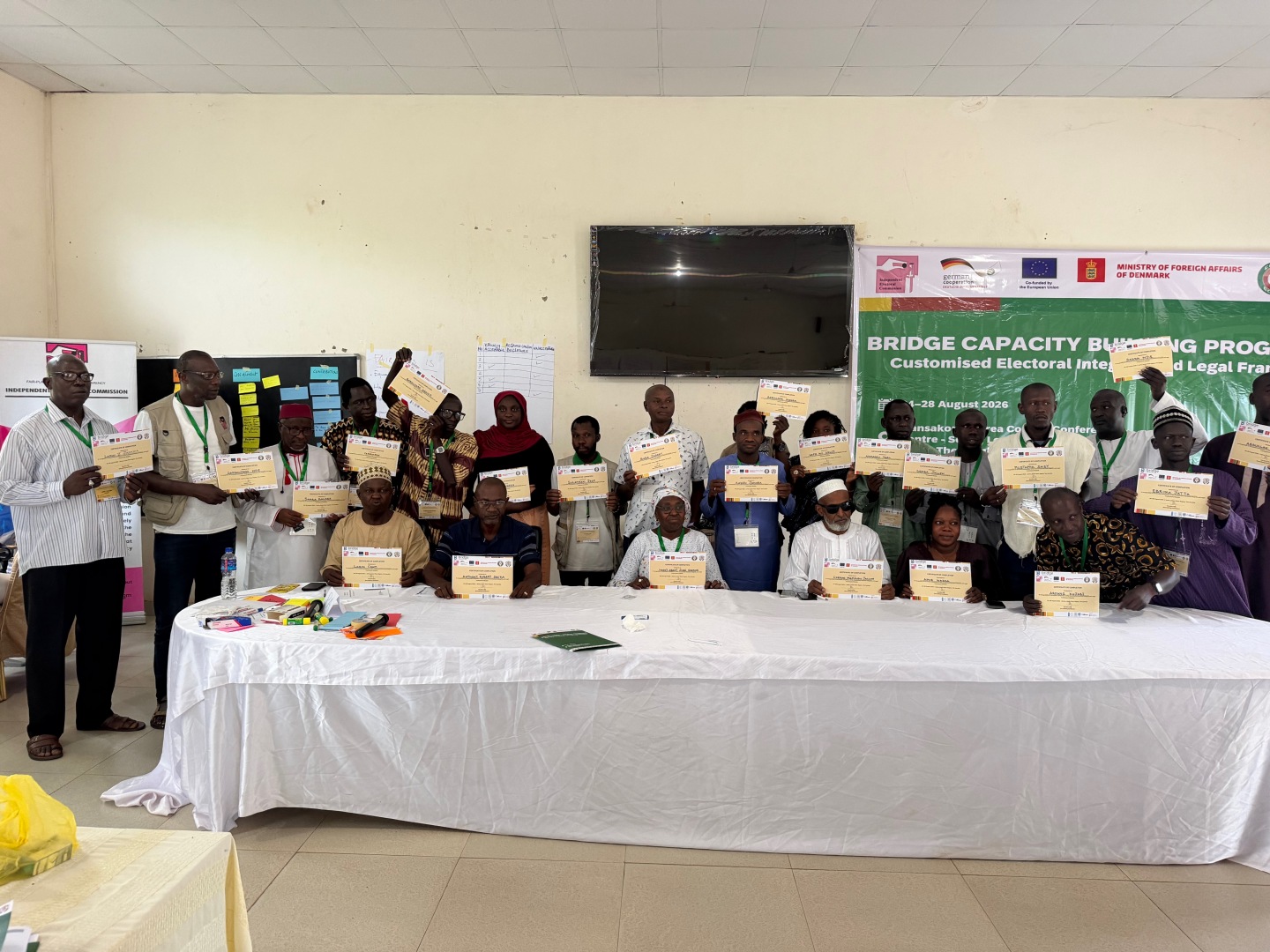
From 24 to 28 August 2026, Soma, in The Gambia’s Lower River Region, hosted a five-day BRIDGE training on Electoral Integrity and Legal Framework, bringing together key stakeholders of the Gambian electoral process to strengthen their knowledge, capacities and commitment to credible, transparent and inclusive elections.
Held at the Mansokoko Conference Centre, the training was organized by the ECOWAS Electoral Assistance Division and ECOWAS Network of Electoral Commissions (ECONEC), in partnership with the Independent Electoral Commission (IEC) of The Gambia, with the technical and financial support of GIZ, within the framework of the ECOWAS Support for Peace, Governance and Security Programme.
The training formed part of broader efforts to strengthen electoral governance, democratic institutions and stakeholder capacity in The Gambia, while promoting a shared understanding of the legal and institutional foundations of electoral integrity.
Strengthening knowledge of electoral integrity
The BRIDGE methodology provided participants with a highly participatory and experience-based learning environment. Rather than focusing solely on theoretical presentations, the training encouraged participants to examine real-life electoral situations, discuss challenges and identify practical solutions collectively.
Throughout the five days, participants explored key dimensions of electoral integrity, including the legal and constitutional framework governing elections, the rights and responsibilities of electoral stakeholders, the role and mandate of the electoral management body, electoral procedures, transparency, accountability, fairness and the prevention and management of electoral disputes.
Particular attention was given to the practical application and understanding of The Gambia Elections Act 2025, enabling participants to better appreciate how the legal framework translates into responsibilities and actions at different stages of the electoral cycle.
A platform for dialogue among electoral stakeholders
One of the major strengths of the training was its inclusive and participatory nature. It brought together different actors involved in the electoral process and created an opportunity for constructive dialogue and experience-sharing.
Through group exercises, case studies, simulations and facilitated discussions, participants examined some of the challenges that may affect the credibility and legitimacy of elections.
The training also highlighted the importance of trust, transparency, impartiality and accountability in electoral processes. Participants recognized that electoral integrity is not the sole responsibility of the electoral management body. It is a shared responsibility involving political parties, candidates, civil society organizations, the media, voters, observers and other relevant institutions and stakeholders.
From electoral rules to electoral culture
A central message emerging from the five-day training was that credible elections cannot be guaranteed by legal provisions alone.
Strong laws and procedures must be complemented by responsible behaviour, ethical leadership, institutional professionalism and respect for democratic principles.
The discussions therefore went beyond the technical aspects of election administration to address the broader political and social environment in which elections take place.
Participants were encouraged to view electoral integrity as a collective democratic culture, grounded in respect for the law, equal treatment, peaceful political competition, access to reliable information and the protection of citizens’ electoral rights.
Building capacity for prevention and effective electoral dispute management
The training also placed emphasis on identifying and addressing vulnerabilities throughout the electoral cycle.
Participants explored how electoral disputes can emerge, the different categories of electoral disputes, and the importance of prevention, dialogue and appropriate redress mechanisms.
This preventive approach is particularly important in strengthening resilience against electoral tensions and ensuring that disagreements are managed through institutional and peaceful mechanisms rather than through confrontation.
The BRIDGE methodology provided participants with practical tools to identify risks, analyse potential consequences and develop appropriate responses.
A significant professional milestone for the IEC
An important outcome of the training was the full accreditation of Mr. Pa Makan Khan, Director of Communication of the Independent Electoral Commission of The Gambia, as a BRIDGE facilitator.
Mr. Khan had previously been semi-accredited, and his participation in the Soma training enabled him to complete the requirements for accreditation.
His accreditation represents an important achievement not only at the individual professional level, but also for the IEC, as it contributes to strengthening the Commission’s internal capacity to facilitate and deliver BRIDGE-based electoral training.
The development of a pool of accredited national facilitators is particularly valuable for ensuring the sustainability of capacity-building initiatives and reducing reliance on external expertise over time.
Strengthening The Gambia’s democratic institutions
The Soma training reflects the importance attached by ECOWAS and its partners to strengthening electoral governance and democratic resilience in the region.
By bringing together electoral officials and other key stakeholders, the initiative contributed to creating a common understanding of electoral standards and responsibilities while encouraging dialogue across institutional and political boundaries.
The technical and financial support provided by GIZ through the ECOWAS Support for Peace, Governance and Security Programme further demonstrates the importance of sustained investment in democratic governance, peace and security in West Africa.
Looking beyond the training room
The conclusion of the five-day BRIDGE training should not mark the end of the learning process. Rather, it should serve as a starting point for applying the knowledge and skills acquired in participants’ respective institutions and organizations.
The sustainability of electoral integrity ultimately depends on the extent to which the principles discussed during the training are translated into everyday institutional practices and responsible political behaviour.
The experience in Soma demonstrated that capacity-building can also serve as a platform for dialogue, trust-building and collective problem-solving among electoral stakeholders.
A shared commitment to credible elections
The five days in Soma delivered an important message: credible elections are built long before election day.
They require strong institutions, clear and respected legal frameworks, competent electoral professionals, responsible political actors, ethical media, an active civil society and informed citizens.
The BRIDGE training on Electoral Integrity and Legal Framework therefore constituted an important step towards strengthening The Gambia’s electoral ecosystem and reinforcing the capacity of national stakeholders to contribute to peaceful, transparent and credible elections.
As participants returned to their respective institutions and organizations, the challenge is now to transform the knowledge gained in Soma into concrete action and to continue building a culture of electoral integrity based on trust, accountability, inclusion, professionalism and respect for the rule of law.